Skip to content


This is probably the third blog you’re reading today about “AEO” – answer engine optimization, or “SEO for AI tools.” So, sorry about that. But there is something that I fear is getting lost in the conversation.
Yes, AEO is heavily dependent upon clear content and obvious authority. Yes, page structure – key information on top, a clear “who” – is important. And yes, standard E-E-A-T still applies. That’s all pretty standard to the (not incorrect) talking point that AEO is just a continuation of the SEO best practices you’ve used for years.
What isn’t being talked about enough is the fact that LLMs are lazy both by design and by necessity. (More like LAIzy, amirite?)

AI Is Lazy, and I’m Not Talking About Cheating on Your Homework
Depth Is Expensive and AI Knows It
The simple fact of the matter is that user-facing chatbots backed by modern models are wildly expensive to run. Estimates vary wildly, but a cent or so per GPT 5.2 query including basic web research is probably reasonable. Regardless of the exact number, every inference carries a cost, and more complex tasks require more inference. (And most tasks start from users paying a flat monthly fee, or nothing.)
This means that answer engines are existentially tied to utilizing the easiest sources possible. “Easier” – big names like Wikipedia or Crunchbase, aggregations with tons of usable content in one place, or highly structured exact-match content – mean less inference, which means less compute, which means less cost. The result is laziness in how answers are generated: What’s presented to the user as comprehensive research is always biased toward a few types of information sources. The models don’t go further because they can’t afford to go further.
The lesson for digital marketers: Don’t assume that ChatGPT, et al, will give you the same thorough “read” nor context that 2019 Google offered. Depth is costly, and they’re burning ungodly amounts of cash. Try to give the bots as much as you can as fast as you can, even if it means mentioning competitors and making your content simpler (i.e., boring). If you serve it up on a silver platter, they’re going to take it.
In which I get persnickety about gas station chains, and in the process make a solid point about localization pitfalls
Eli Lilly’s plan to build a $3.5B injectables/device plant outside Allentown, Pennsylvania, has been massive news this week. It’s a big deal for the company, and a huge deal for the region Altitude calls home.
But as important as the story is for the industry (continued investment in onshore production) and the region (dollars and jobs), it also has something to do with gas stations, and marketing localization.
Gas station affinity – the Wawa-Sheetz rivalry, in particular – is a weirdly big deal in Pennsylvania. Your chain preference is both a regional and cultural signifier; a bit of shorthand for “cosmopolitan” vs. rural, or Philly vs. everyone else. People mostly care good-naturedly, but also kind of … not.
What does this have to do with Eli Lilly? Anis Fahandej-Sadi’s TLDR Biotech newsletter – which I genuinely adore, and to which you should subscribe – led its coverage of the new facility with a GIF of the Sheetz logo. The explanation: “Sheetz looks to be the dominant convenience store chain in Pennsylvania.”
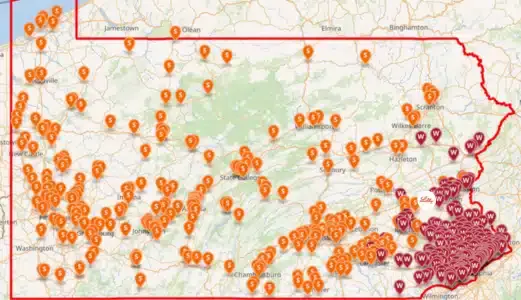
In a sense, that’s correct – Sheetz does seem to have slightly more statewide locations than Wawa. However – and here’s the marketing lesson – context always makes things more complicated. If you define the geographic area as Pennsylvania, sure, the Sheetz GIF is fine. But Pennsylvania is a big state, and residents tend to identify as part of a specific region.
In this case, Lilly is building in Fogelsville, in the Lehigh Valley – the area north of the Philadelphia suburbs. And while Fogelsville is close to the dividing line between traditional Sheetz territory and traditional Wawa territory – yes, that’s a thing – it’s culturally pretty firmly in the Wawa camp. You can see it here in white, laid onto a map from Wikipedia:
The Point:
As marketing and content have gotten more targeted, we’ve leaned into localization and personalization. That means we’re playing on our targets’ home turf. And that means the bar for understanding is higher than it’s ever been. What’s technically correct might strike the specific reader or viewer as wrong, because their context is different. Personalization – good – becomes a demonstration of outsider status – bad – with something seemingly innocuous. (It’s the “Inglourious Basterds” three fingers.) So take care, and take the extra time to research. Most won’t, and your message will be better received for it.
Ready to elevate your B2B marketing?
We help leading business-to-business brands hit their marketing goals. Get in touch to learn how Altitude Marketing can help you reach your peak performance.