Skip to content


The way B2B buyers shortlist for vendors is changing. Adoption of AI search platforms like Claude, OpenAI, and Perplexity have steadily chipped away at Google’s dominance.
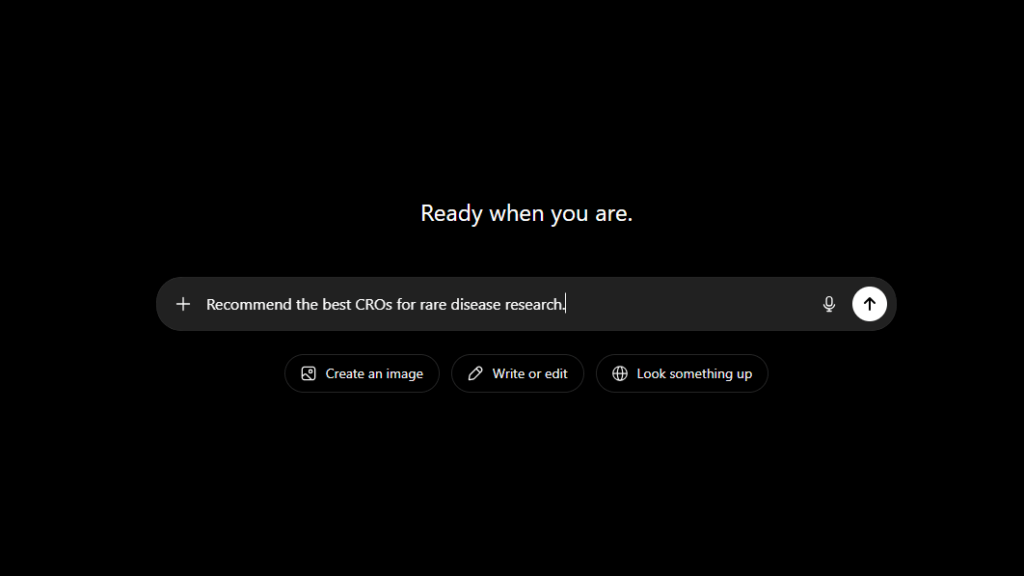
This shift represents a fundamental change in buyer behavior that’s happening right now, in the industries you sell to. Prospects are no longer typing keywords into Google and clicking through a list of links. They’re asking direct, context-heavy questions: Which vendors are the leaders in automated torque calibration? What’s the best ERP for mid-market biotech? Who are the top B2B marketing agencies for life sciences companies?
The answers they get back are not a ranked list. They’re a synthesized response with a vendor shortlist embedded inside. If your company isn’t in that shortlist, it doesn’t exist for that buyer — at least not at the moment it matters most.
This is the operational reality of answer engine optimization (AEO): the practice of optimizing your content and digital presence to appear in AI-generated answers, not just traditional search engine results pages. And it’s no longer a forward-looking concern. It’s a present-tense visibility problem.
Notably, even Google — the search engine AEO is often framed as a threat to — has acknowledged the shift. In its official guide to optimizing for generative AI features, Google now explicitly addresses how AI Overviews and AI Mode surface content, and what it means for how websites should position themselves. Google’s guidance reframes AEO as the natural evolution of sound SEO — which is accurate, but understates what B2B companies specifically need to do differently.
6 Content Marketing Tips for the Life Sciences
The Change That Actually Matters: How B2B Buyers Search Now
Traditional B2B search was rarely a discovery mechanism for unknown brands. A procurement manager searching “industrial cooling solutions” or a CTO looking for “ERP systems for contract manufacturers” wasn’t usually stumbling onto a new vendor for the first time via Google. Discovery happened at trade shows, through referrals, in industry publications. Google search was mostly confirmatory — validating companies already on a shortlist, checking technical specs, reading case studies.
AI search is beginning to inverted that model.
Today, buyers are increasingly using AI platforms in the formation phase of the buying journey. They aren’t necessarily starting with a vendor in mind. They’re asking an open question and receiving a pre-assembled shortlist.
For B2B companies, this means the initial vendor shortlist — the list that determines who gets invited to the table— is being drafted by an AI system before a human buyer has visited a single website.
Buyers in the complex industries most B2B companies serve already start their search with a high degree of insular knowledge. They are not using AI search platforms for education about a general category or product. They’re using these tools to compare and shortlist specific companies.
That’s a categorically different buyer behavior than what SEO was designed to address. And it’s a critical factor in how you create and execute on your AEO content strategy.
Traditional SEO is Still Relevant, But With New Context
To be clear: SEO still matters. Total search usage — combining traditional search engines and AI platforms — has grown 26% worldwide since 2025. AI search isn’t replacing Google; it’s expanding the total search landscape. A company that abandons its SEO foundation to chase AEO is making a mistake.
But a company that only optimizes for traditional keyword rankings is quietly disappearing from the channel where its buyers are forming shortlists.
The mechanics of the two systems are different enough that success in one doesn’t guarantee visibility in the other. Traditional SEO was built on keyword density, backlink authority, and technical site health — signals designed to rank pages within a list. AI search works differently. When an AI generates a vendor recommendation, it’s drawing on:
Semantic understanding of intent. AI models don’t match keywords — they interpret questions. A buyer asking “which vendors are best for validation testing in regulated environments” will get an answer that synthesizes content about FDA compliance, quality systems, and validation methodology, regardless of whether any single page targeted that exact phrase. This is what Google describes as query fan-out: the model generating a set of concurrent, related sub-queries to build a comprehensive answer from multiple sources.
Source credibility signals. AI systems are trained on patterns of authority. Content from recognized industry publications, original research, and consistently cited sources carries more weight than an isolated blog post — even a well-ranked one.
Topical depth and consistency. An AI model assessing whether your company is a legitimate authority on a topic isn’t looking at a single page. It’s evaluating the breadth and coherence of everything you’ve published on that topic over time.
Freshness. Platforms like Perplexity actively index recent content. A well-sourced piece published this quarter has a real advantage in time-sensitive queries.
The gap between traditional SEO performance and AEO visibility is the core problem Altitude sees in almost every content audit we perform. A company can rank on page one of Google for several competitive keywords and still be absent from every AI-generated shortlist in its category. The same E-E-A-T signals, expert-driven content, and authority-building that rank you in Google are the same signals that get you cited in AI answers — but traditional SEO is the foundation, and AEO is the next layer.
What AEO Actually Requires for B2B Companies
There is no single “AEO algorithm” because there is no single AI search engine. ChatGPT, Claude, Perplexity, Gemini, and Microsoft Copilot all have different training data and different credibility evaluation methods. But across all of them, the following principles hold — and map directly to what Google has now formalized in its own guidance.
Build Hyper-Specific Solution Content — Not 101-Level Education
Most B2B content strategies are still built around awareness-stage, top-of-funnel content: “What is [category]?” and “Benefits of [product type].” That content served a purpose in a keyword-ranking model. In an AI-driven buying environment, it’s largely wasted effort.
Instead of 101-level education blogs, B2B companies should prioritize content that directly addresses specific buyer personas and provides transparent comparisons with competitors. This most accurately reflects how buyers actually draft prompts — and the structure in which AI responses are delivered.
The buyer asking an AI for vendor recommendations isn’t asking “what is a CRO?” They’re asking “which CROs have Phase II oncology experience and FDA-compliant facilities in North America?” Your content needs to answer the second question, not the first.
Google’s guidance reinforces this, noting that commodity content — something like “7 Tips for First-Time Homebuyers” — is based on common knowledge that could originate from anyone and adds little unique insight. Non-commodity content, by contrast, provides unique expert or experienced takes that go beyond common knowledge and the ordinary.
Establish Topical Authority Through Content Clusters
A single well-written blog post doesn’t make you an authority on a topic. AI models recognize consistent, deep expertise — the kind that comes from publishing multiple interconnected pieces on a subject over time.
Build content clusters: a foundational piece on each core topic your buyers care about, detailed explorations of subtopics and buyer-specific applications, technical resources, and regular updates as the landscape evolves. A company that publishes fifteen substantive articles on clean room validation over two years looks like a category expert. A company that published one blog on the topic in 2022 does not.
This isn’t just an AEO principle. It’s what Google has always rewarded under E-E-A-T (Experience, Expertise, Authoritativeness, and Trustworthiness). AEO sharpens the requirement because AI systems need sufficient signal density to confidently cite a source.
Prioritize Verifiable Claims and Source Citations
AI models are trained to reward verifiability. If your content makes specific technical or market claims without substantiation, an AI system is less likely to treat it as authoritative, and more likely to deprioritize it in favor of sources that cite their evidence.
This means citing within your content: linking to peer-reviewed research, industry reports, recognized data sources. It means attributing specific statistics rather than asserting them. It means writing in a way that makes your reasoning, not just your conclusions, visible. Google’s guidance frames this as the distinction between content that is helpful, reliable, and people-first versus content that simply restates information already available elsewhere.
Publish Original Research
Original research is the highest-value AEO asset a B2B company can produce. AI models are trained on a vast corpus of existing content, most of it derivative. Original data — a buyer survey, a benchmark study, a proprietary analysis of market conditions in your vertical — is harder to replicate and carries disproportionate weight when an AI is synthesizing an authoritative answer.
If you serve a specific industry, consider commissioning original research on questions your buyers actually ask: state-of-the-market reports, adoption benchmarks, cost analyses. For example: The CDMO Marketing Trends Report and Pennsylvania Manufacturing Marketing Trends Report published by Altitude.
These become defensible citation assets. Original research is one of the highest-leverage levers in that effort.
Build a Footprint Beyond Your Own Website
This is where many B2B content strategies have their biggest gap. If the entirety of your thought leadership lives on your blog, you have a single point of authority. AI systems evaluate credibility partly through the breadth of a brand’s footprint; how often it’s cited, referenced, and mentioned by sources other than itself.
Quality, third-party links from industry aggregators — resources like G2 for enterprise software, ThomasNet for industrial companies, or Biocompare for life sciences — consolidate valuable information in a single source, which means they are the easiest place for LLMs to build a company shortlist first. Guest content in recognized trade publications, earned media mentions, and contributions to respected industry forums all contribute to the signal pattern AI systems use to assess authority.
Google makes the same point in its generative AI guidance, noting that AI features surface content from across the web — not just well-ranked pages. Our generative AI search features can show what’s being said about products and services across the web, including in blogs, videos, and forum discussions.
Maintain a Technically Sound, Crawlable Site
The fundamentals haven’t changed. A fast, well-structured website that follows crawlability best practices is a prerequisite for any search visibility — traditional or AI-driven. To be eligible to be shown in generative AI features on Google Search, a page must be indexed and eligible to be shown in Google Search with a snippet.
From proper schema markup to the addition of an llms.txt file at the site’s root, to pulling technical information out of image files or PDFs, ensuring there’s no friction when AI crawlers want to read your website is a core AEO technical requirement.
One thing worth noting: Google explicitly advises against certain “AEO hacks” that have gained traction in the industry — including creating elaborate AI-specific markup files and “chunking” content into artificial segments. Google’s systems are able to understand the nuance of multiple topics on a page and show the relevant piece to users, so content should be structured for human readers, not gamed for AI parsers.
AEO and SEO Are the Same Strategy at Different Levels of Ambition
The framing of AEO as an alternative to SEO is a false choice. The two practices share the same foundation: authoritative, well-sourced, deeply expert content, published consistently, on a technically sound website, with a broad external footprint.
What AEO adds is specificity of intent. The content needs to reflect how buyers actually prompt AI systems — which means it needs to address specific comparison questions, specific use cases, and specific buyer profiles, not generic category definitions.
The same content quality and authority signals that drive SEO success are foundational to AI visibility — but AEO adds a distinct set of strategies around content structure, entity optimization, and earned media distribution.
Companies that get AEO right almost automatically improve their SEO as well. The reverse is not reliably true — a page optimized only for keyword rankings may rank well on Google and remain completely invisible in AI-generated vendor shortlists.
Where to Start
If your B2B company hasn’t audited its content for AEO readiness, these are the highest-priority starting points:
Audit for topical depth. Map all your existing content against the topics your buyers actually research. Where you have one or two pieces, you need a cluster. Where you have no content, you have a blind spot.
Identify your original insight opportunities. What data or observations does your company have access to that no one else does? Proprietary benchmarks, customer outcome data, and deep vertical expertise are your most defensible AEO assets.
Test how you appear in AI search today. Open ChatGPT, Perplexity, or Claude and ask the questions your buyers are asking. Ask for vendor recommendations in your category, with the specific requirements your target buyers typically have. If your company doesn’t appear, that’s your baseline — and your roadmap.
Build a third-party placement strategy. Identify the trade publications, industry aggregators, and authoritative platforms in your vertical. If your content is almost entirely on your own site, that ratio needs to change.
Align with your SEO foundation. None of this replaces technical site health, backlink authority, or keyword strategy. It adds a layer on top of it. Start with the gap analysis between what’s ranking in traditional search and what’s being cited in AI responses — that gap is where the work is.
The B2B companies that will have disproportionate organic visibility over the next several years are building this discipline now, while the field is still underpopulated. The window is open. Altitude’s B2B SEO and AEO practice is built around exactly this intersection — the technical foundation, the content depth, and the external authority signals that make brands visible wherever their buyers are actually searching.